

Blue Spirulina: What It Is, What It Tastes Like, How to Use It
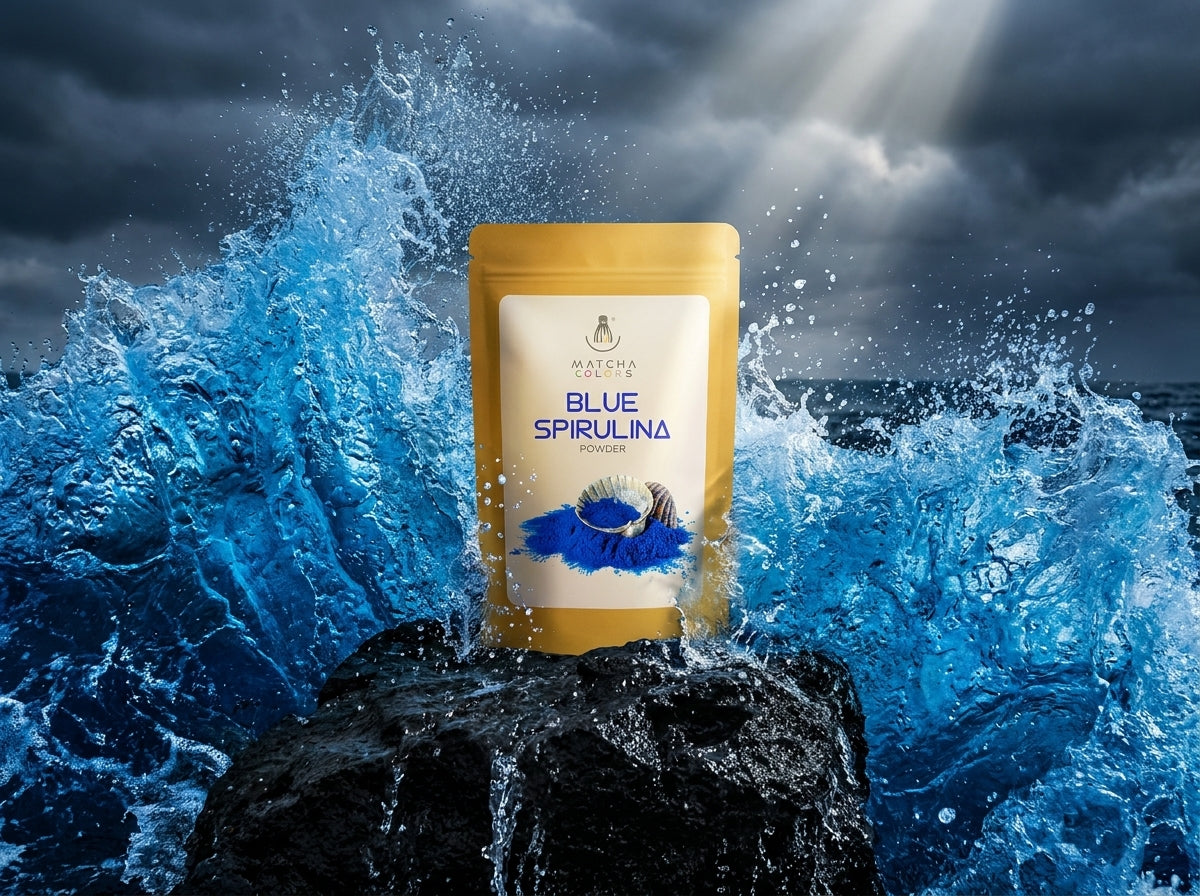
Blue spirulina is one of those ingredients you see once in a video and never forget: an electric blue powder that turns a glass of milk a colour that looks impossible in something natural. Then the questions start. Is it the same as the green spirulina everyone knows? What does it taste like? How much do you use? And why do some people get a brilliant blue while others end up with a murky grey?
This guide answers all of that from practice — what we have learnt making drinks with blue spirulina every day.
What blue spirulina actually is
Spirulina is a microscopic cyanobacterium, Arthrospira platensis, grown in fresh water and dried into a powder. That powder is the one you know: dark green, almost black, with a strong smell.
Blue spirulina is not a different algae or a separate cultivated variety. It is an extract of that same spirulina. A single water-soluble pigment, phycocyanin, is separated out of the green powder, and everything else is left behind: the green chlorophyll, the fibre, the fatty fraction and — this is the part that matters in the kitchen — almost all of the smell.
Put simply: green spirulina is the whole algae; blue spirulina is one pigment isolated from it. That is why the colour is so clean, and why the price per kilo is higher — it takes many kilos of algae to make one of extract.
Why it is blue and not green
Spirulina holds two pigments at once. Chlorophyll, which is green, and phycocyanin, which is blue. In the whole algae the chlorophyll dominates and hides the blue completely, the way a few drops of black ink hide a glass of blue-tinted water.
Extract only the phycocyanin and you see the colour that was there all along. That blue is not an added dye: it is the algae's own pigment, concentrated. The ingredient list on our blue spirulina is a single line, and that is it.

What blue spirulina tastes like
This is the question we get most, so here is the honest answer: very little.
If you are expecting green spirulina — that sea-floor, dried-seaweed background you have to bury under banana and cacao — you are in for a surprise. Taking the green fraction out of the algae takes almost all of the flavour with it. What is left is a very neutral, faintly mineral profile, with a distant hint of sea water that most people do not spot unless you point it out. In a drink with milk and a little sweetness, it disappears.
That has a genuinely useful consequence: blue spirulina is used for colour, not for flavour. You can turn a lemonade, a yoghurt or a vanilla shake blue without changing what it tastes like. With green spirulina that is impossible.
If you want a blue that brings flavour too, the ingredient is a different one: butterfly pea flower, with its soft herbal, vegetal note. We compare the two below.
How much to use: less than you think
Mistake number one is overdoing it. Phycocyanin stains enormously, and a heaped spoonful does not give a prettier blue — it gives an opaque, almost inky blue that turns earthy in the mouth.
- One glass (250 ml): between 1/4 and 1/2 level teaspoon. Start at 1/4.
- A pastel latte blue: the tip of a teaspoon, barely more.
- Baking and icings: just as little, always dissolved first in a few drops of cold liquid.
Always dissolve it separately, in a little cold liquid, before it goes into everything else. Tipped straight into a full glass it leaves lumps that break up in your mouth and deliver all that mineral note at once.
Heat and lemon: what dulls the colour
Phycocyanin is a delicate pigment. Three things spoil it, and they are worth knowing before you blame the powder:
1. Heat
Above roughly 60 °C the blue starts shifting to a dull green and then to grey. That is why blue spirulina is a cold drink ingredient: lemonades, smoothies, iced lattes, yoghurts, ice cream. For something warm, heat the milk first, let it come down in temperature, then stir the powder in at the end, off the heat. A steam wand at full blast will kill it.
2. Light and time
Once made, a drink loses intensity within hours. Make it to order. Keep the jar closed, in a dark, dry cupboard.
3. Acid, up to a point
There is a nuance here. Phycocyanin copes reasonably well with a mildly acidic medium — a blue lemonade works — but a lot of lemon juice plus heat will degrade it. And it does not turn pink: that is another ingredient's trick.
Blue spirulina or butterfly pea: which for what
These are the two natural blues in the kitchen and they get mixed up constantly, but they behave very differently.
| Blue spirulina | Butterfly pea | |
|---|---|---|
| What it is | Pigment extracted from an algae | Whole ground flower (Clitoria ternatea) |
| Colour | Electric blue, intense and opaque | Indigo blue, more translucent |
| Taste | Almost none, faintly mineral | Soft herbal and vegetal |
| With lemon | Stays blue | Turns pink and violet |
| Best for | Colouring without touching flavour | The colour-change effect |
If what you want is the party trick — a drink that goes from blue to pink in front of people — you need butterfly pea, and we walk through it in our blue lemonade recipe and in the blue latte that changes colour.
If what you want is a stable blue that stays put and cannot be tasted, it is the spirulina.

How to choose a blue spirulina
Quality varies a lot and the packaging does not always tell you. Three things to check:
- The ingredient list. It should have one ingredient. If maltodextrin, starch or "colouring" appear, you are paying for extract and taking home filler.
- Actual strength. A weak extract makes you use three times the powder for the same blue, so the cheap jar works out dearer per glass and tastes of more.
- Origin and testing. Spirulina is grown in water, which makes heavy-metal control essential. Ask for, or look for, batch analyses.
Ours is pure extract, no fillers and no sugar, in the same fine powder format as the rest of the colour range. You can see it here: blue spirulina powder.
Three easy ways to start
- Blue lemonade. Cold water, juice of half a lemon, a dash of syrup and 1/4 teaspoon dissolved separately. Ice last.
- Iced blue latte. Dissolve 1/4 teaspoon in a splash of cold milk, stir well, pour over a glass of milk and ice. The gradient makes itself.
- Yoghurt or breakfast bowl. The tip of a teaspoon into plain or coconut yoghurt, stirred until even. Fruit on top.
In all three: cold, a small amount, dissolved first. Do that and you will never get lumps or a sad blue again.
Frequently asked questions
What does blue spirulina taste like?
Very little. Because it is an extract of the pigment rather than the whole algae, it loses almost all of green spirulina's flavour. What remains is a very neutral, faintly mineral profile that is barely noticeable in a drink with milk or a little sweetness. That is exactly why it is used to add colour without changing taste.
Is it the same as green spirulina?
No. It comes from the same algae, Arthrospira platensis, but the green is the whole algae ground up and the blue is only one of its pigments, phycocyanin, separated from the rest. Colour, taste and price all differ.
How much blue spirulina goes in a glass?
A quarter to half a level teaspoon per 250 ml. Start at a quarter — it stains far more than it looks like it will, and overdoing it gives an opaque blue and an earthy finish.
Can you heat it?
Better not. Above about 60 °C the blue shifts to dull green and then grey. For a warm drink, heat the liquid first, let it cool a little, and stir the powder in at the end, off the heat.
Why did my drink turn greenish or grey?
Almost always temperature — the liquid was too hot. The other two usual causes are making it hours ahead, since the colour fades with time and light, or tipping the powder straight into a full glass instead of dissolving it separately.
Can you mix it with matcha?
Yes, and it is one of the prettiest ways to use it. A green matcha with a thread of blue milk gives a striking gradient. Bear in mind that if you fully blend the two powders, green and blue add up and the result tends towards turquoise.
Where can I buy blue spirulina in Europe?
We ship from Spain — 1-2 working days across mainland Spain and 2-4 to the rest of Europe. You can see it on the blue spirulina powder page, with the full ingredient list and available format.

